This morning I woke up thinking about materials.
.
If you're a beadworker how much import does intrinsic value, time, skill, uniqueness and love involved have on your choice of materials?
.
Is something automatically more beautiful because the gems are grade A? Perhaps it depends on your personal sense of style and not just the depth of your pockets.
.
As a beadweaver I often choose beads at a mid-range price. I'm not shy about mixing less expensive Czech beads with more expensive Japanese beads to get the effect that I want. In my stringing I hardly ever go for the sparkle of well cut grade A gems or even crystals except for special commissions.
.
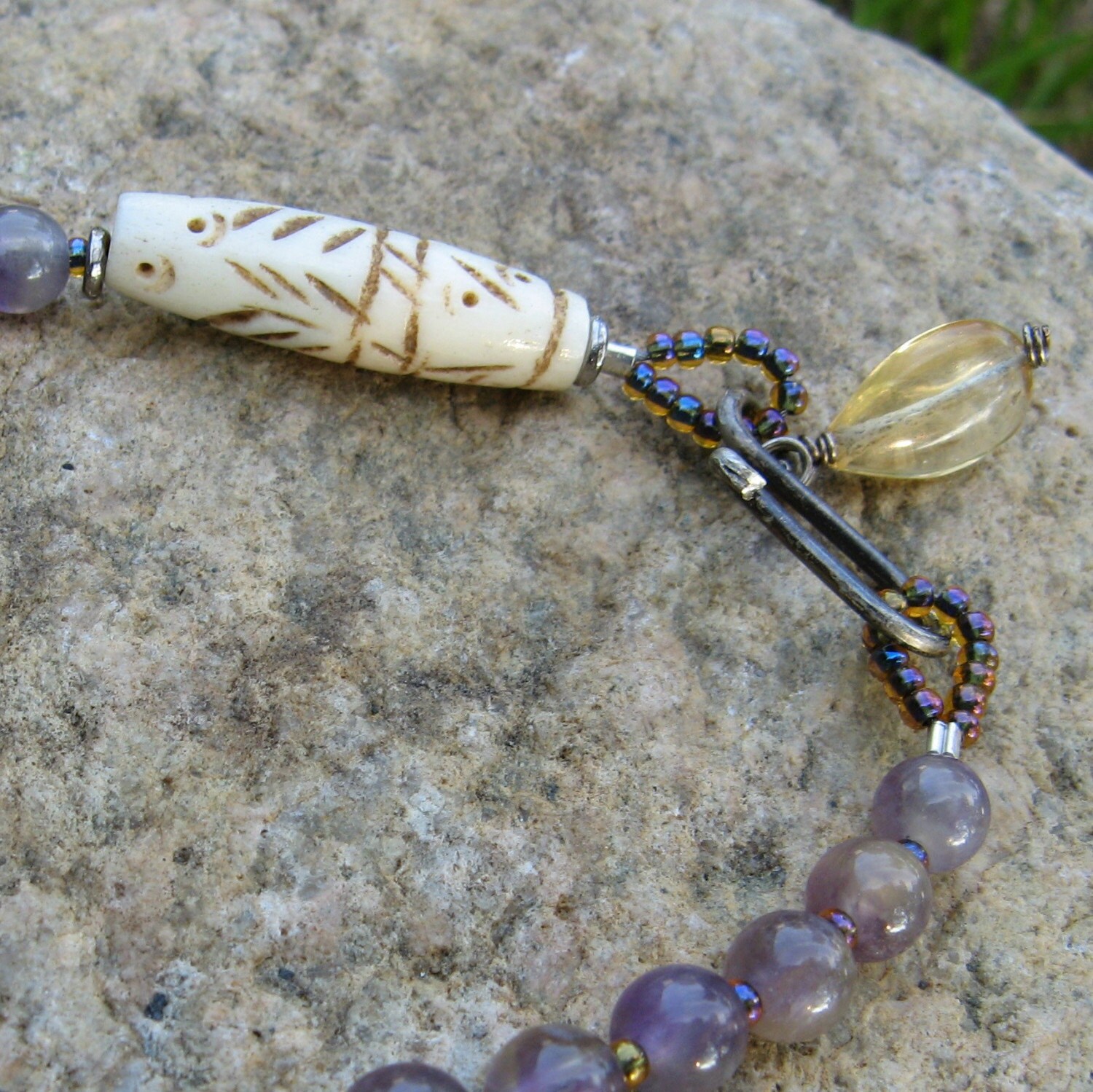
I recently had request for something like the sold bracelet in the picture. Actually, by the time I finished the only things that were the same were the amethyst and seed beads. The amethyst is what some would call poor quality. It's solid and the holes are well done so the beads should last forever, but the color! It doesn't have a clear purple color! In places it's downright grey in other places almost yellow, very quartzy. I love it. Both of my customers, the one that bought the original and the one that wanted something similar agreed that it's a lovely interesting look for amethyst.
The citrine is handcut, meaning it lacks the precision of a machine cut gem with it's sharp, perfect facets. A swift look at my shop will reveal a predilection for raw, earthy, primitive styles, so all this is within character for me.
It depends on what I'm going for, of course. If I really want sparkle I'll get Swarovski. But if I want a bead I can work with, I get what appeals.
There is a school of thought that suggests that the first beads in use by man were things that already had holes or things that were easily pierced, like seeds or feathers. That makes sense to me. It seems obvious. Children pick treasures up before they make their own.
At some point we graduated grandly to materials that took skill to work, but that would last longer.
Isn't the time and skill involved in creation of more value than the actual material?
Glass and clay are cheap, but put those humble materials in the hands of a master and look what treasures there are to be had!
.
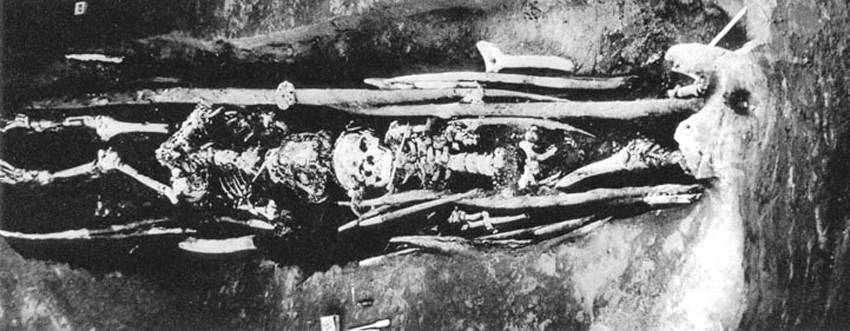
Some evidence of early man's fascination with beads has been found in Russia.

In
Valerie Hector's The Art of Beadwork, she points out that the more than 10,000 mammoth ivory beads buried with these children would have taken more than 3 years worth of 8 hour days to create. That's a lot of love.
Surely that love adds to the value of a piece of art, even if the materials are common.
.
I love, too, the unique. I love artist's beads. If you start with something no one else has, you'll end up with something no one else has. But then you can also start with the most typical of materials, think seed beads, and still end up with something no one else has. Thank God for that!